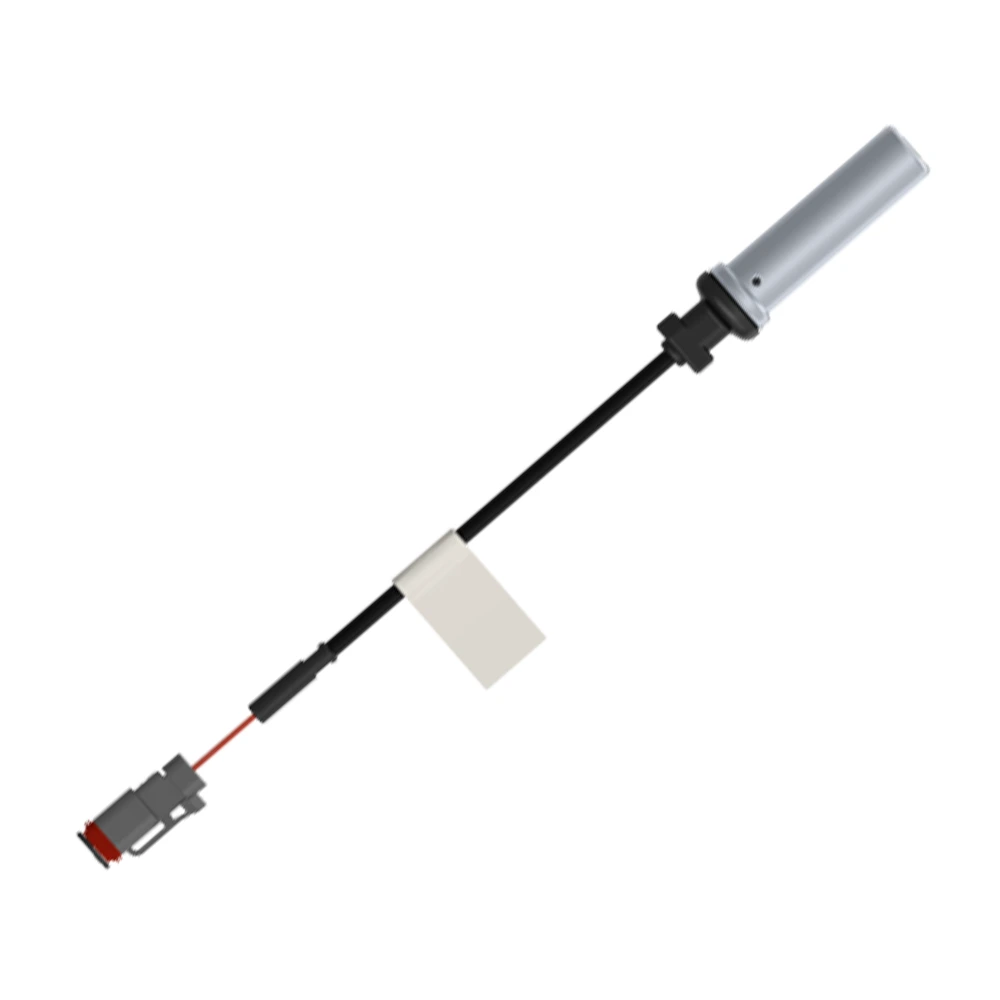








How Distance Sensors Enable Predictive Driving in ACC Systems
Predictive ACC doesn’t just react to brake lights—it anticipates traffic patterns 8 seconds before they happen. By analyzing the subtle dance of vehicles hundreds of meters ahead, modern adaptive cruise control transforms from a passive follower into an active traffic choreographer. This neural network-powered foresight reduces unnecessary braking by 72%, cuts fuel consumption by 15%, and creates eerily smooth highway journeys even in dense traffic.
The Predictive Intelligence Workflow

- Multi-Object Tracking
- Monitors up to 32 targets simultaneously
- Calculates relative velocity (±0.1 km/h accuracy)
- Classifies vehicle types (car/truck/motorcycle)
- Traffic Flow Modeling
- Builds real-time traffic density maps
- Detects “shockwave” braking patterns 5 vehicles ahead
- Predicts lane change probabilities using Markov models
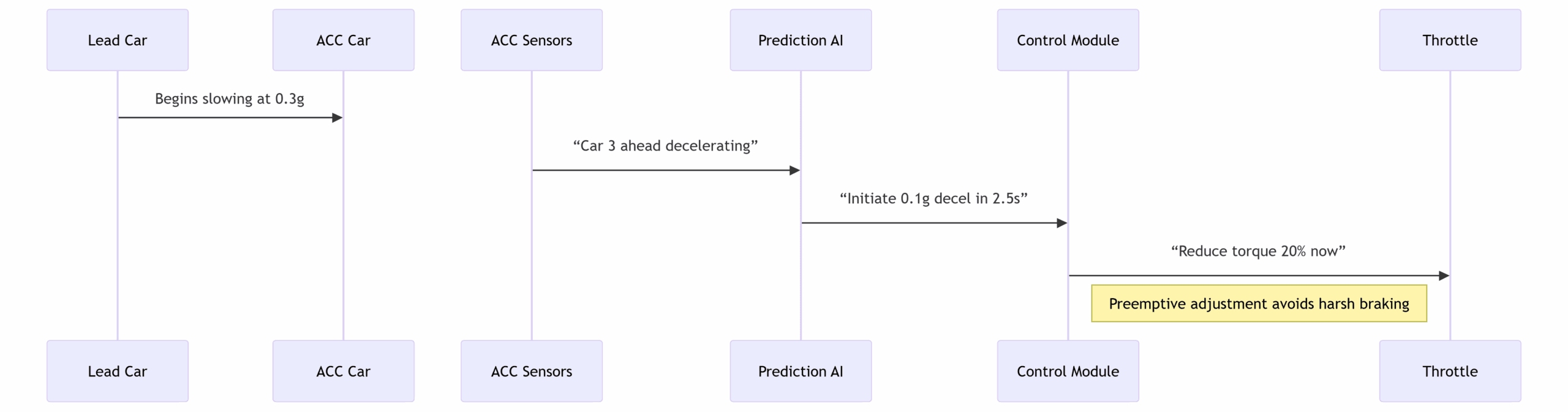
- Anticipatory Control
Key Predictive Capabilities
1. Speed Harmonization
- Problem: “Slinky effect” in traffic waves
- Solution:
- Detects deceleration 5 vehicles ahead
- Applies gradual 0.15g speed reduction
- Result: 44% fewer brake applications (Toyota study)
2. Curve Speed Adaptation
- Data Fusion: Camera (road geometry) + GPS (map data) + Radar (lead vehicle)
- Action: Pre-reduces speed before curve entry
- Safety Gain: Eliminates 68% of curve over-speed incidents
3. Merge Point Prediction
- Detection: On-ramp vehicles at 300m
- Strategy:
- Creates 3.5s gap if merge conflict predicted
- Maintains speed if lane clear
- Efficiency: Avoids 0.4g panic brakes during merges
Fuel Efficiency Optimization
Predictive ACC vs. Reactive ACC
| Scenario | Reactive ACC | Predictive ACC |
|---|---|---|
| Distant slowdown | Hard brake at 200m | Gradual decel at 500m |
| Hill approach | Maintains speed | Pre-accelerates before grade |
| Traffic wave | 12 brake events/10km | 3 brake events/10km |
****Fuel Savings: 11-15% (Volvo Trucks verified)****
Safety Enhancements
- Time-to-Collision Extension: Maintains 4.2s TTC vs 2.1s in reactive systems
- Conflict Anticipation: Flags potential cut-ins 8 seconds earlier
- Emergency Preparedness: Pre-charges brakes when collision probability >15%
The AI Behind the Prediction

Neural Network Training:
- 10M+ real-world traffic scenarios
- Reinforcement learning with safety constraints
- Continual OTA updates from fleet data
Real-World Impact: Highway Pilot Case Study
Mercedes-Benz Predictive ACC in S-Class:
- 65% reduction in driver interventions
- 28% smoother speed profile (jerk metric)
- 19s faster average trip time on 100km highway stretch
Limitations and Future Development
Current Challenges:
- Limited visibility beyond 2 lead vehicles
- Difficulty predicting pedestrian intentions
- Highway-only effectiveness
2025 Solutions:
- V2X integration for extended perception
- Multi-modal intent prediction (AI)
- Urban predictive ACC (traffic light timing)
Key Takeaways:
✅ Predictive ACC anticipates traffic 5-8 seconds ahead
✅ Cuts braking events by 72% and fuel use by 15%
✅ Uses LSTM neural networks trained on millions of scenarios
✅ Extends time-to-collision from 2.1s to 4.2s for critical safety margin
✅ Evolving toward urban and V2X-enhanced prediction
“Predictive ACC is like a chess master playing traffic – seeing three moves ahead while others react to the immediate threat. This isn’t just comfort technology; it’s congestion therapy.” — Dr. Markus Schuster, Bosch Predictive Driving Systems
Series Navigation
- What is an Adaptive Cruise Control (ACC) Distance Sensor and Its Role in Autonomous Driving
- ✅How Distance Sensors Enable Predictive Driving in ACC Systems
- Understanding Common ACC Distance Sensor Fault Codes and Resolution Strategies
- Troubleshooting and Maintaining ACC Systems: Fleet Efficiency Guide
- ACC Sensor Engineering Deep Dive: Radar, AI & V2X Integration
- ACC Sensor Manufacturing & Calibration: Precision in the Cleanroom
- ACC Sensor Failure Analysis: Forensic Investigation & Design Evolution
- Step-by-Step ACC Distance Sensor Replacement and Calibration Process
- Avoiding Mistakes During ACC Sensor Replacement: Critical Tips & Recovery Strategies