







What is an Adaptive Cruise Control (ACC) Distance Sensor and Its Role in Autonomous Driving
Adaptive Cruise Control (ACC) distance sensors are the “digital co-pilots” transforming highways into autonomous corridors. These sophisticated eyes don’t just maintain speed like conventional cruise control – they track vehicles ahead, predict movement patterns, and orchestrate precise acceleration/braking. By continuously scanning 200+ meters downrange, ACC sensors form the foundational layer for autonomous driving’s collision-free future.
ACC Sensor Technologies Compared

How ACC Sensors Enable Autonomous Driving
1. Perception Layer Foundation ACC sensors continuously scan the road, providing:
- Real-time distance to leading vehicles (1cm precision)
- Relative speed calculations (±0.1km/h accuracy)
- Object classification (car/truck/motorcycle)
2. Predictive Driving Intelligence
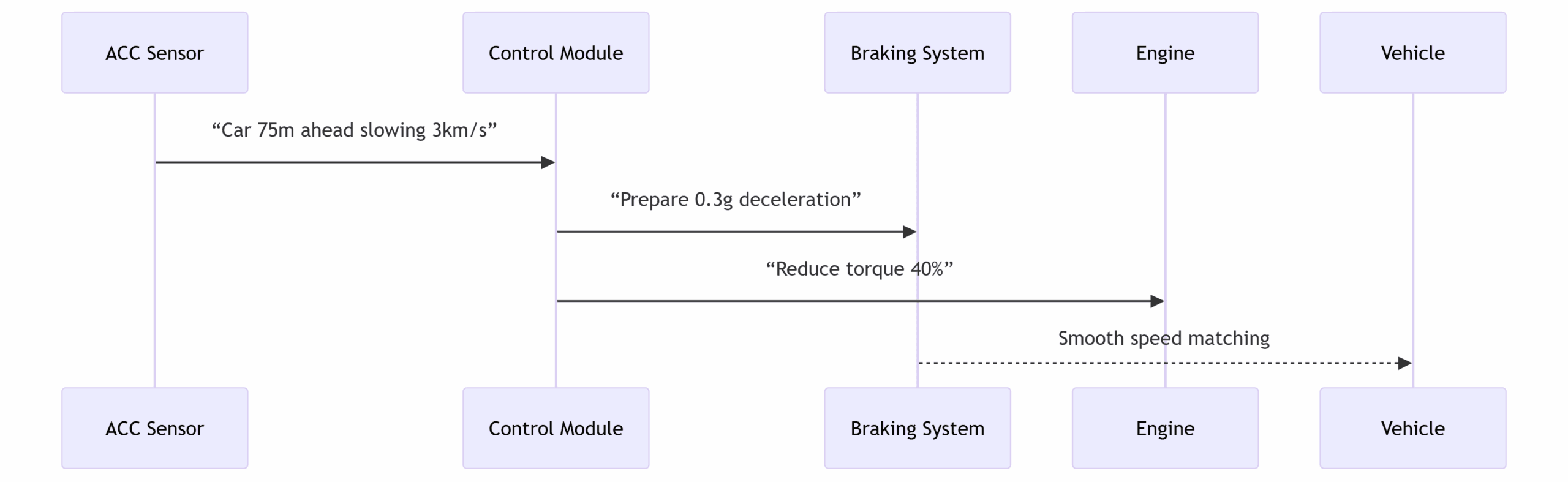
3. Autonomous Function Enablement
| Autonomous Feature | ACC Sensor Contribution |
|---|---|
| Highway Autopilot | Maintains safe following distance at 130+ km/h |
| Traffic Jam Assist | Stop-and-go control under 60 km/h |
| Predictive Energy | Anticipates hills/flow for optimal efficiency |
| Emergency Braking | Collision avoidance at 0.8g deceleration |
Evolution Toward Full Autonomy
Sensor Capability Progression

Autonomy Level Enablement
- Level 1 (Driver Assistance): Basic speed/distance control
- Level 2 (Partial Automation): Combines with lane centering
- Level 3 (Conditional Automation): Manages all driving in ODD*
- Level 4+ (High Automation): Sensor fusion with 360° coverage
*Operational Design Domain – specific road/environment conditions
Cutting-Edge ACC Sensor Specifications
| Parameter | Automotive Grade | Autonomous Grade |
|---|---|---|
| Detection Range | 160m | 300m+ |
| Angular Accuracy | ±0.5° | ±0.05° |
| Update Frequency | 10Hz | 25Hz |
| Object Separation | 1.5m | 0.3m |
| Latency | 100ms | 20ms |
| Fail-Operational | No | Dual-redundant |
The Autonomous Future: ACC as Nervous System
By 2030, ACC sensors will evolve into integrated perception hubs:
- V2X Communication: Broadcast position/speed to infrastructure
- Collective Perception: Share sensor data across vehicle fleets
- Road Health Monitoring: Detect potholes/obstacles for municipal alerts
- Predictive Safety: Anticipate cross-trajectory conflicts 500m ahead
“Today’s ACC sensors are the stem cells of autonomy – initially performing simple functions, but containing the DNA to grow into fully autonomous nervous systems.” – Dr. Anika Patel, Autonomous Systems Lead, NVIDIA
Key Takeaways:
✅ ACC sensors combine radar/lidar/camera for all-condition operation
✅ Enable critical autonomous functions like traffic jam assist
✅ Provide the spatial awareness foundation for L2-L4 autonomy
✅ Evolving toward V2X-connected road ecosystem integration
✅ Require redundant fail-operational designs for higher autonomy levels
This technological evolution turns every highway commute into a synchronized safety ballet – where sensors see what humans can’t, predict what we don’t, and respond faster than our reflexes allow.
Series Navigation
- ✅What is an Adaptive Cruise Control (ACC) Distance Sensor and Its Role in Autonomous Driving
- How Distance Sensors Enable Predictive Driving in ACC Systems
- Understanding Common ACC Distance Sensor Fault Codes and Resolution Strategies
- Troubleshooting and Maintaining ACC Systems: Fleet Efficiency Guide
- ACC Sensor Engineering Deep Dive: Radar, AI & V2X Integration
- ACC Sensor Manufacturing & Calibration: Precision in the Cleanroom
- ACC Sensor Failure Analysis: Forensic Investigation & Design Evolution
- Step-by-Step ACC Distance Sensor Replacement and Calibration Process
- Avoiding Mistakes During ACC Sensor Replacement: Critical Tips & Recovery Strategies