







Design Principles and Sensing Technologies Behind Automotive Accelerometers
The true value of a longitudinal acceleration sensor lies in what’s inside — not just the signal it sends. From MEMS microstructures to signal processing algorithms, automotive-grade accelerometers are sophisticated devices built for extreme environments. In this article, I’ll explain how these sensors are constructed, how they detect motion, and what makes their design reliable for integration into modern vehicle systems.
1. MEMS-Based Sensing: The Core Technology
The vast majority of automotive accelerometers today are based on MEMS (Micro-Electro-Mechanical Systems). These are tiny, silicon-based structures etched using semiconductor fabrication techniques.
How MEMS accelerometers work:
- A central proof mass is suspended by micro-springs within a silicon substrate.
- When the vehicle accelerates forward or backward, the mass shifts.
- The displacement changes the capacitance between fixed and movable electrodes.
- An analog circuit converts this capacitance change into an electrical signal proportional to acceleration (in g).
MEMS accelerometers offer a compact footprint, low power consumption, and high resistance to vibration — ideal for in-vehicle electronics.
2. Capacitive Sensing vs. Other Methods
Capacitive MEMS sensing is the most commonly used principle for longitudinal accelerometers because it offers:
- High sensitivity at low frequencies (DC–1 kHz)
- Low noise characteristics
- Excellent linearity
- Minimal drift over temperature
Alternatives like piezoelectric and piezoresistive sensors are occasionally used in motorsport or crash-sensing applications, but not typically for continuous acceleration measurement in vehicle dynamics systems.
3. Signal Processing Architecture
Inside a longitudinal acceleration sensor module, the signal processing typically includes:
| Stage | Purpose |
|---|---|
| Charge amplifier | Converts capacitance change into voltage |
| Low-pass filter | Eliminates high-frequency vibration noise |
| Temperature compensation | Adjusts signal for thermal drift |
| A/D conversion | Digitizes the analog signal |
| Output interface | CAN, SENT, or analog voltage driver |
Some sensors also include:
- Self-diagnostics (e.g., offset check, stuck-at detection)
- Redundant sensing elements (for fail-safe ESC systems)
In high-integrity systems (ASIL B or higher), dual-core or redundant signal paths are used to ensure data reliability.
4. Axis Alignment and Sensor Orientation
Correct orientation is essential in longitudinal acceleration sensing:
- The sensor must be aligned along the X-axis (vehicle front–back).
- Even a few degrees of misalignment can introduce significant lateral/vertical error due to cross-axis sensitivity.
Design considerations:
- Housing includes orientation marks for assembly
- Sensors are often embedded within PCBs inside sealed enclosures
- Software calibration may include rotational correction matrices
During mass production, we test sensor axis response on 3D shaker tables to validate alignment and axis purity.
5. Mechanical Packaging for Automotive Durability
An automotive longitudinal accelerometer must endure:
- Vibration (up to 20 g RMS)
- Wide temperature range (–40°C to +125°C or more)
- Chemical exposure (oil, brake fluid, salt spray)
- Moisture ingress (IP67/IP69K sealing)
Typical packaging features:
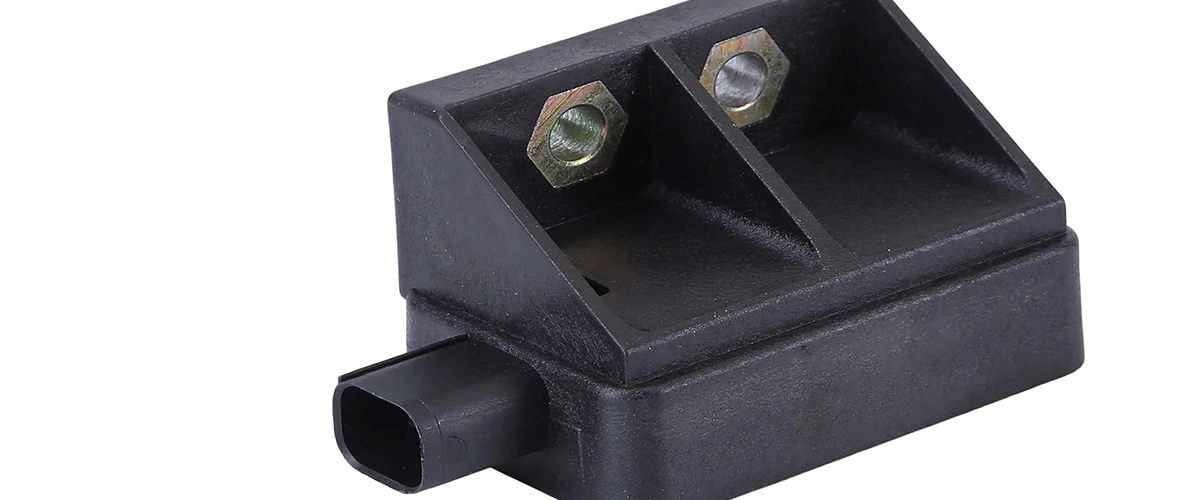
- Thermoplastic or metal enclosures
- Potting compound or gel-filled cavities to protect MEMS die
- PCB-mounted modules or standalone sensor units with robust connectors
6. Calibration and Output Stability
Sensors are individually calibrated during production to ensure:
- Zero-g offset within ±0.03 g
- Scale factor accuracy within ±2%
- Thermal drift compensation over the full automotive temperature range
Advanced calibration techniques:
- Laser trimming of resistors
- EEPROM-based calibration maps
- Factory-level 3-axis dynamic testing
Calibration is what transforms raw silicon into a mission-ready automotive sensor.
Behind every acceleration sensor is a precise blend of MEMS engineering, signal processing, and automotive-grade packaging. Understanding these design principles helps ensure sensor selection and integration match your vehicle’s control and safety requirements.
As we often say in development: “A stable MEMS platform is the foundation of stable vehicle dynamics.”
Series Navigation
- Understanding Longitudinal Acceleration Sensors in Modern Vehicles
- ✅Design Principles and Sensing Technologies Behind Automotive Accelerometers
- Performance Parameters: Accuracy, Bandwidth, and Drift
- Testing and Qualification of Acceleration Sensors
- Why Acceleration Sensors Fail: Top Causes, Failure Modes, and Diagnostic Guide
- How to Troubleshoot Acceleration Sensors in Modern Vehicles
- How to Install an Acceleration Sensor: Step-by-Step Guide
- Common Mistakes in Acceleration Sensor Replacement